
How BioExchange streamlines access to biospecimens
In preclinical research and drug development, access to high-quality biospecimens with specific inclusion and exclusion criteria remains a major bottleneck. Even the most promising projects can stall for months while teams search for suitable samples, negotiate access, and coordinate logistics.
BioExchange from Specie Bio is designed to change that. It’s an AI-driven matchmaking platform that connects researchers directly with hospitals, medical centers, biobanks, and research institutions that have the samples and data they need — all from a single search.
BioExchange currently searches across millions of banked samples with linked medical data from institutions worldwide. Its AI data ingestion engine harmonizes metadata across heterogeneous data sources, allowing natural-language search to drive precise matching.
And for providers, it’s an opportunity to make underused collections discoverable and generate new research impact — while maintaining control over access and terms.
How BioExchange Works
If you’re looking for samples or datasets, you can easily see if BioExchange’s network of providers has what you need. Here’s how it works:
1. Search
Start by entering criteria for the samples and data you are looking for— such as tissue type, disease state, required clinical annotation.
To make finding samples even easier, our AI chat assistant helps maximize your search success by asking a short series of questions. It ensures details necessary for providers to accept your request are included in the search query, accelerating the matching process.
Researchers can search across diverse sample types, including:
Blood (whole blood, plasma, serum, PBMCs)
Tissue (primary tumor, metastatic tumor, matched normal tissue)
DNA, RNA, and other biomaterials
Fluids such as CSF or urine
Samples across a variety of disease areas including oncology and immunology
BioExchange’s AI-driven matching engine searches across its global network of providers, to find preliminary matches. Immediately see how many samples and associated medical data meet your needs. You can further refine search criteria based on preliminary matches.
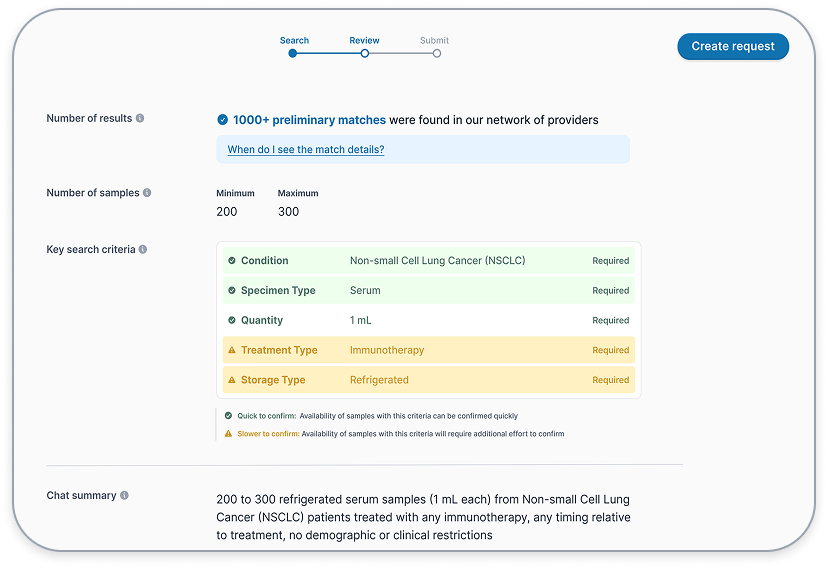
Once you are ready, fill out a request with information such as budget and timeline so relevant providers can confirm the match.
2. Match
Once a request is submitted, BioExchange notifies the providers of preliminary matches so they can confirm sample availability. Generally, this takes about 1-3 weeks depending on the complexity of the request.
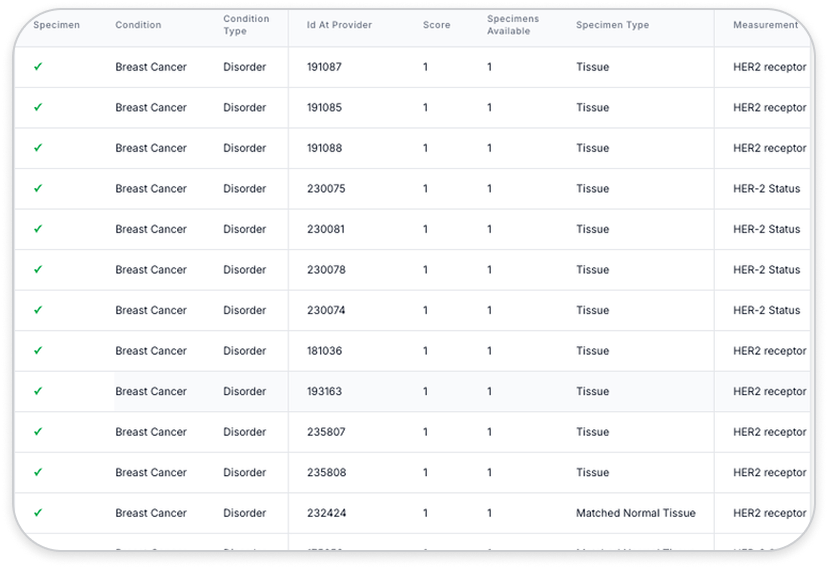
After provider confirmation, you will receive detailed information for all match options. You can review all options and decide which provider(s) you would like to proceed with.
3. Exchange
After mutual confirmation, BioExchange facilitates introductions with your matched provider(s), enabling a transparent, direct relationship between both parties. The expedited agreement process used by our provider network streamlines the time it takes to get samples or data delivered. Typically, researchers receive samples or data within 1-3 weeks, depending on the provider. BioExchange helps facilitate the process through delivery to ensure quality and timeliness.
BioExchange by Specie Bio offers a faster, smarter way to access biospecimens and medical data for research. By uniting global providers into one searchable network and enabling direct, transparent exchanges, BioExchange helps researchers accelerate projects, reduce costs, and focus on innovation.
Interested to see if we have the samples or data you are looking for? Search now →
